Against Overture 56
The accused deserve assistance and representation

By Brad Isbell
Because I have been busy with selling a business (successful, transition nearly complete) and finding a house to move to another state (thus far unsuccessful), I have not been writing or podcasting much at all. I have not missed a PCA General Assembly since 2017 and have served as a commissioner at every assembly since 2018. This year, I will not attend, and I am not much in the loop, which is why I did not immediately notice that a Book of Church Order (BCO) amendment overture had been submitted to undo the gains secured by one I wrote in 2024, which was ratified last year and has been the law of the church for barely a year.
My proposed amendment sought to “Amend BCO 32-19 To Expand Representation of Accused Persons Before Church Courts.” Of the 69 presbyteries voting on the amendment in 2025, 64 voted in favor.
Very simply, a person accused in a local church can look outside that church for assistance and may now have the same representation from the session level to the presbytery to the General Assembly (Standing Judicial Commission). And, at every level, that representative need not be a teaching elder. The benefits of this change for vulnerable persons are obvious.
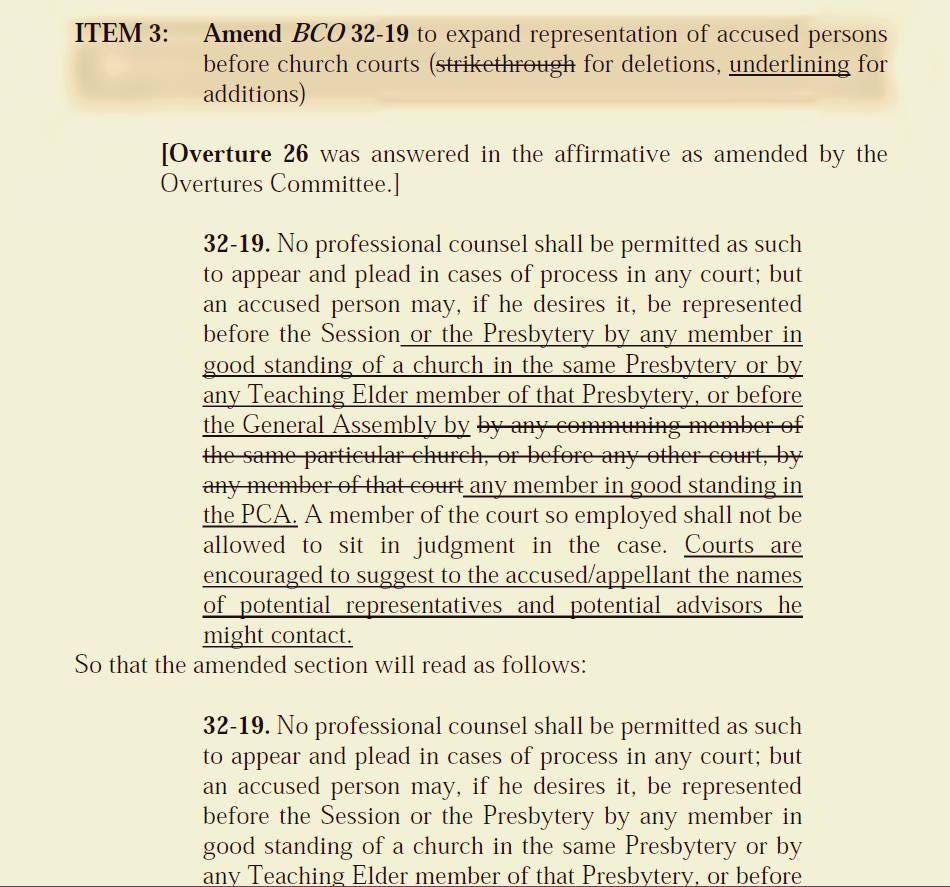
Presbyterian process is good and biblical, but (based on the real-world experience of many), it seemed necessary to make it easier for accused persons (who may be young, new to the PCA, or past victims of abuse) to find and keep representatives of their choice, not having to rely on members of their own church (which may be very small) or members of the “pastors club” that presbyteries sometimes seem to be.
Yet, this year, Overture 56 would seek to roll back the expansions that my 2024 overture sought and gained) and would actually narrow the pool of representatives for cases before the Standing Judicial Commission. Accused persons and appellants would have fewer choices than they did prior to 2025 (see lines 14 & 15 below).
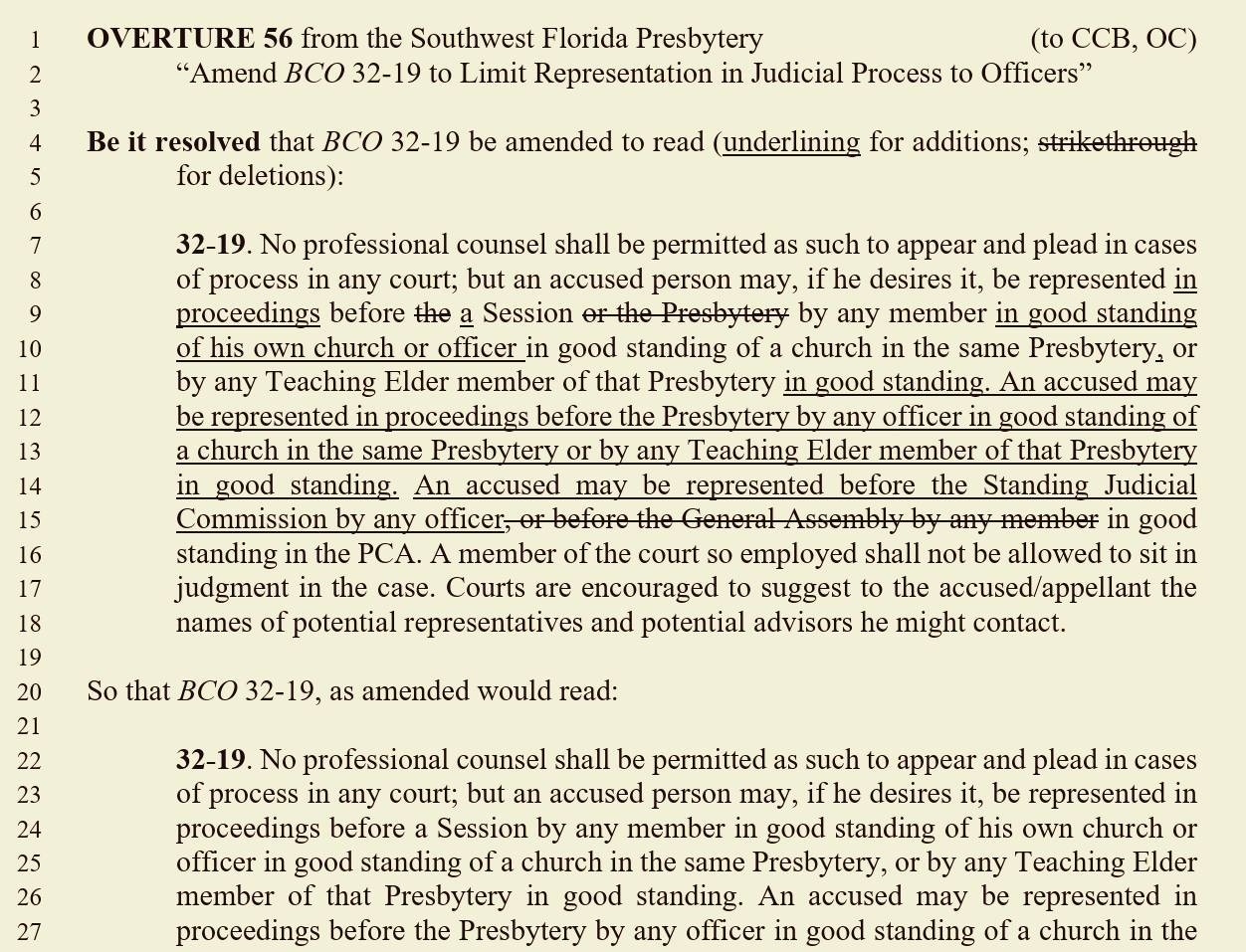
There is no good reason to make it harder for people accused in the church. Keeping people “in the system,” is one of the hardest things for presbyterian churchmen. Too often, the daunting nature of our disciplinary processes is a factor in members fleeing the system and therefore leaving the church. One of the goals of discipline is restoration, but once members flee a difficult system, they are beyond the help of their elders. All elders of long experience know that “happy” endings in church discipline cases are rare. Preserving the current provisions of BCO 32-19 makes restoration—and the rejoicing that can come with it— more likely.